
Crawl Space Vapor Barrier in Pasadena, CA
Crawl space encapsulation and vapor barrier services use a polyethylene or reinforced plastic sheeting system installed across the soil floor and up the foundation walls of your crawl space to block ground moisture before it reaches your subfloor, floor joists, and living space above. In Pasadena, where the combination of clay-heavy soils in areas like Altadena-adjacent foothills and periodic wet winters pushes ground moisture upward year-round, an undersized or deteriorating barrier is one of the most common causes of musty odors, warped hardwood floors, and elevated indoor humidity we document on inspections. Most Pasadena homes with a vented crawl space see meaningful improvement within the first season after a properly installed barrier system – and we can show you the before-and-after documentation to verify it.
If you’re trying to understand whether your crawl space needs a new barrier, a repair, or a full encapsulation, you’re in the right place. This page covers what a vapor barrier does, when you need one, what our installation process looks like, and what it costs in this market. You can also read more about the full scope of work on our Crawl Space Encapsulation & Vapor Barrier in Pasadena page. Or if you’d rather talk through your specific situation, call us at (213) 816-5351 – a live person picks up, no voicemail loop, no callback window measured in business days.
Topside Attic Insulation Pasadena has operated under The Haven Standard since 2016. Every job starts with a written price before any work begins, and every job closes with a documented photo record so you know exactly what was installed and where.
When You Need a Crawl Space Vapor Barrier
Some of the signals are obvious. Others take a trained eye and a moisture meter to confirm. Here are the situations we see most often in Pasadena that point to a failing or absent vapor barrier:
- Musty or earthy odor inside the home. If your first floor smells like a damp basement when you walk in on a winter morning, ground moisture is almost certainly moving through an unprotected crawl space floor and into your living space. In Pasadena homes built before 1980 – particularly in the bungalow stock around the Bungalow Heaven Landmark District – original vapor barriers were typically thin, single-ply sheeting that has long since degraded.
- Elevated indoor humidity between November and April. Pasadena’s wet season pushes more moisture into the soil than most homeowners expect. When we run a blower-door test – a pressurization measurement that shows, in one figure, how much air your building envelope is losing – on homes during January inspections, we routinely find crawl space moisture is a major driver of RH readings above 60% on the ground floor.
- Visible mold or mildew on floor joists. Mold on wood framing is a sign the relative humidity in the crawl space has been sitting above 70% for an extended period. We document this with photos on every inspection visit, so there is no ambiguity about what was found before we quote any work.
- Warped, soft, or squeaky hardwood floors. Wood expands when it absorbs moisture. In San Marino and East Pasadena homes with original hardwood, this is one of the first complaints we hear – and the crawl space is often where the investigation ends.
- Higher-than-expected utility bills in winter. Ground moisture and cold subfloor temperatures act together to pull heat out of the living space. A functioning vapor barrier, paired with proper crawl space insulation, addresses both the moisture and the thermal loss in one scope of work.
- A previous barrier that is torn, bunched, or incomplete. We see this constantly in older Pasadena properties where a prior contractor laid a thin 6-mil sheet without overlapping seams or securing it to the foundation walls. Over time it shifts, rodents punch through it, and it stops doing its job. A photo record from a prior inspection – if one exists – is the best way to establish the baseline before we discuss repairs versus full replacement.
Our Crawl Space Vapor Barrier Process
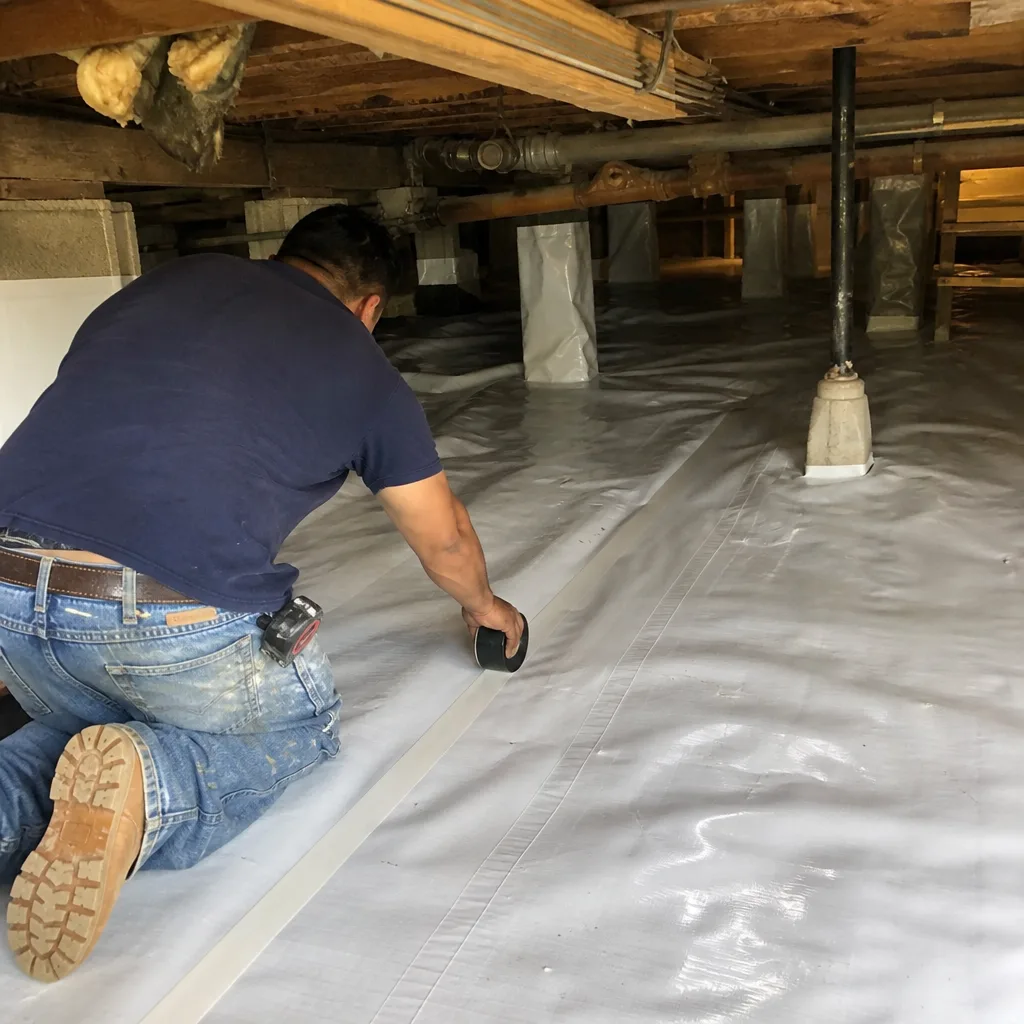
We follow a documented sequence on every vapor barrier installation. The order matters: we do not skip steps or treat installation as a simple roll-and-tape job. Here is what happens from the moment we arrive at your Pasadena home to the moment we leave with a closed job packet.
- Pre-installation inspection and moisture reading. Before we unload a single roll of material, we enter the crawl space and take baseline moisture readings at multiple points across the subfloor and soil. We photograph the existing condition – standing water if present, existing sheeting condition, visible mold, pest evidence, and insulation status. This documentation is yours to keep. If we find something that changes the scope of work, we tell you before we start, not after.
- Debris removal and surface preparation. Rocks, old insulation scraps, deteriorated sheeting, and organic debris are removed from the crawl space floor. We are not installing a vapor barrier over a surface that will puncture it or trap decaying material underneath. This step is what separates a lasting installation from one that fails in three years.
- Seam and penetration planning. We map the crawl space geometry before cutting material. Every pipe penetration, pier, and support post gets a planned detail – because an unsealed penetration is a gap that makes the rest of the barrier less effective. In Pasadena crawl spaces with older cast-iron plumbing (common in homes built through the 1960s in areas like Madison Heights and Bungalow Heaven), we document each penetration point photographically as part of the scope record.
- Barrier installation – floor and wall coverage. We install heavy-duty reinforced poly sheeting across the entire crawl space floor, overlapping seams by a minimum of 12 inches and sealing them with a compatible tape rated for below-grade applications. The sheeting runs up the foundation walls and is mechanically fastened before being sealed at the termination point. The goal is continuous coverage with no gaps at transitions – not approximate coverage. The specific barrier product we use is selected based on crawl space conditions; we work with materials from established manufacturers including Johns Manville and Owens Corning, with no proprietary product requirement.
- Penetration sealing and finishing details. Every pipe, post, and column that penetrates the barrier gets individually sealed. This is where most budget installations cut corners. We treat the penetrations as part of the air and moisture control plane, not as afterthoughts.
- Post-installation documentation and walk-through. When the crew is done, we photograph the finished installation from multiple angles and prepare a written job record that includes the materials used, coverage area, and any conditions noted during the inspection. You get a copy before we leave. Under Haven Standard Clause 1, you had a written price before work started – the closing documentation is the other half of that commitment.
Crawl Space Vapor Barrier Pricing in Pasadena
How much does crawl space encapsulation and vapor barrier cost in Pasadena? Most installations run between $1,200 and $4,500, depending on crawl space square footage, access difficulty, existing conditions, and barrier specification. Here is how those variables typically break down:
- Small crawl space (under 800 sq ft), good access, minimal prep needed: $1,200 – $1,900. This covers a straightforward single-story home with a clean, dry crawl space that just needs updated barrier material.
- Mid-size crawl space (800 – 1,500 sq ft), standard conditions: $1,900 – $3,000. Most Pasadena homes from the 1940s through 1970s fall in this range. Expect some debris removal and penetration sealing to be part of the scope.
- Larger or more complex crawl space (1,500+ sq ft, low clearance, or significant prep required): $3,000 – $4,500 and up. Homes in the Foothills area, San Pasqual Valley-adjacent properties, and larger craftsman homes with irregular foundation layouts can require significantly more labor and material to cover correctly.
What moves the number higher: very low clearance (under 18 inches) that slows crew movement, active moisture or standing water requiring pre-treatment, extensive old barrier removal, large numbers of pipe penetrations, or the addition of crawl space insulation in the same scope. What can bring it lower: smaller footprint, clean existing conditions, and easy access from a full-height access door rather than a tight hatch.
Under The Haven Standard, you receive a written price before any work starts – a flat price against a written scope, not an estimate that expands once the crew is on-site. If you have a competing written estimate, bring it. We will read it with you as part of our free second opinion and tell you exactly what you are comparing.
To get an accurate number for your specific Pasadena home, call us at (213) 816-5351. We will schedule an inspection, document what we find, and hand you a written price before any conversation about starting work.
FAQs – Crawl Space Vapor Barrier
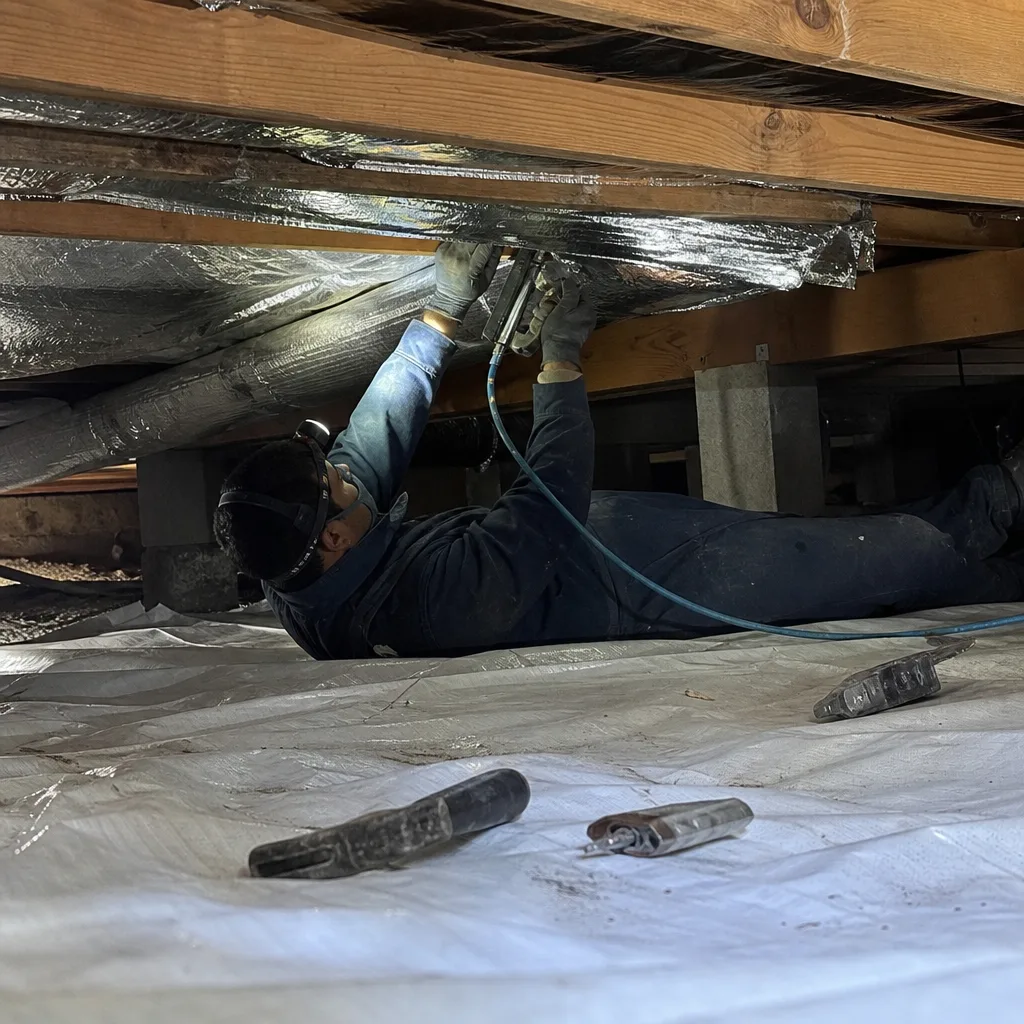
How thick does a crawl space vapor barrier need to be in Pasadena?
For most Pasadena crawl spaces, a minimum of 10-mil reinforced polyethylene is appropriate; we typically install 12-mil or heavier depending on soil conditions and expected foot traffic in the space. California’s Title 24 building energy code does not set a single universal mil rating for all residential vapor barriers, but 6-mil sheeting – which was the standard through the 1970s and 1980s and is still sold at home improvement stores – is undersized for a crawl space that sees regular moisture or pest pressure. The clay soils common in foothills neighborhoods near Pasadena can hold significant moisture and exert more lateral pressure on sheeting at the wall termination points than sandy soils do, which is one reason we specify heavier material in those locations. Call us at (213) 816-5351 for a written price against your specific conditions.
What is the difference between a vapor barrier and full crawl space encapsulation?
A vapor barrier covers the soil floor and foundation walls with a polyethylene membrane to block ground moisture – that is the core function. Full crawl space encapsulation includes the vapor barrier plus sealing the vents, insulating the foundation walls, and in some cases conditioning the space with a dehumidifier, effectively turning a vented crawl space into a semi-conditioned one. In Pasadena’s climate, a vapor barrier alone addresses most moisture issues in homes with existing vented crawl spaces and adequate airflow. Encapsulation makes sense when the space has chronic moisture problems, significant mold history, or when the homeowner wants to condition the space as part of a broader energy improvement. You can read more about the full scope on our Crawl Space Encapsulation & Vapor Barrier in Pasadena page. We will tell you which scope your home actually needs after we inspect it – not before.
Can I install a crawl space vapor barrier myself?
You can purchase the material and lay it yourself, and for a small, clean crawl space with no penetrations and good access, a careful homeowner can get reasonable results. The part that typically goes wrong is the details: unsealed seams, barriers that don’t run up the foundation wall, and penetrations left open. A barrier with gaps at the seams or wall terminations loses much of its effectiveness because moist air migrates around the barrier edges rather than being blocked. If you have documentation of a moisture problem, mold, or a history of pest activity in the crawl space, we would suggest having a professional assess the space first before deciding whether DIY installation is appropriate. The inspection and written quote cost you nothing from us.
How long does a crawl space vapor barrier last?
A properly installed heavy-duty reinforced barrier – 12-mil or heavier, with fully sealed seams and wall terminations – typically performs for 15 to 25 years under normal crawl space conditions. The failure modes that shorten that lifespan are rodent damage, foot traffic that punches through the material at unsupported spans, and seam tape that was not rated for below-grade moisture exposure and eventually releases. We document the installed condition with photos at the close of every job so that when a future inspection is done, there is a clear baseline for comparison. The 365-Day Done Right Promise applies to every installation we complete: if something about the installation is not right, we come back and make it right.
Why Pasadena Homeowners Choose Topside Attic Insulation Pasadena
Since 2016, we have completed work in more than 9,000 homes across the greater Los Angeles area, every one of them under the same operating standard: a written price before work starts and a documented record when the crew leaves. No exceptions for smaller jobs, no verbal agreements that expand once the work is underway.
Pasadena’s housing stock is particular. The city has a high concentration of pre-1950 craftsman homes with original crawl spaces, a significant number of post-war tract homes with concrete perimeter foundations and minimal access clearance, and a growing number of renovated properties where previous contractors layered improvements without addressing the crawl space below. We have inspected enough of these crawl spaces to know what a failing 1970s vapor barrier looks like and what the soil conditions under a North Lake Avenue bungalow do to new sheeting if the seams are not properly taped.
We are also part of a full building-envelope service line, which means if the inspection reveals that the crawl space moisture problem is connected to attic air leakage, insufficient insulation, or a combination of issues, we can address the complete picture rather than patching one layer and leaving the others in place. Learn more about our home service offerings if you want to understand the full scope of what we do.
Wes Okafor leads every job under The Haven Standard principles. When you schedule with us, you get a named technician and a text when they are on the way – not a four-hour arrival window and an anonymous crew.
To schedule an inspection and receive a written price for your Pasadena crawl space vapor barrier, call (213) 816-5351. A live person answers. We will confirm your appointment, tell you who is coming, and document everything we find before any number is put on paper.
Written by Wes Okafor, Owner at Topside Attic Insulation Pasadena, serving Pasadena.