
How Much Does Radiant Barrier Installation Cost in Pasadena?
Radiant barrier installation in Pasadena, CA typically costs between $1,400 and $3,200 for a single-story home with a standard attic, with most jobs landing around $1,800 to $2,400 when the attic is accessible and unobstructed. Homes in neighborhoods like San Marino-adjacent Pasadena or those with complex hip-roof framing – common in older Craftsman and Spanish Revival properties along Prospect Crescent and in the Bungalow Heaven area – tend to run closer to the upper end of that range. At Envelope Insulation Co., every Radiant Barrier Installation services job starts with a written price before any work begins, so there are no surprises when the crew arrives.
Radiant Barrier Installation Cost Breakdown (2026)
Radiant barriers work by reflecting radiant heat – the infrared energy that moves from a hot surface toward a cooler one – rather than absorbing it. In Pasadena, where summer attic temperatures regularly exceed 150°F and cooling bills drive homeowners to act, a properly installed foil barrier on the roof decking can cut attic heat gain by 25 to 40 percent. Here is how the cost typically breaks down across the jobs we see in this market:
| Component | Typical Pasadena Price Range (2026) | Notes |
|---|---|---|
| Foil radiant barrier material (standard single-sided) | $0.10 – $0.20 per sq ft | Most 1,500 sq ft attics use 1,600-1,800 sq ft of material with overlap |
| Foil radiant barrier material (double-sided, perforated) | $0.18 – $0.35 per sq ft | Perforated allows moisture vapor to pass; better suited for Pasadena’s occasional marine-layer humidity |
| Labor – staple-up method (rafters) | $0.65 – $1.10 per sq ft of attic floor | Stapled to the underside of roof decking or draped over rafters |
| Labor – blown-in overlay method | $0.55 – $0.90 per sq ft of attic floor | Foil laid over existing attic insulation; faster install, lower labor |
| Attic access improvement (if needed) | $150 – $400 | Many Pasadena bungalows have undersized hatches that slow installation |
| Attic air sealing (top plates, can lights, penetrations) | $450 – $950 | Completed before any insulation or barrier work at Envelope Insulation Co. – not an optional upsell |
| Complete job – small home (under 1,200 sq ft attic) | $1,400 – $1,900 | Common in Pasadena’s smaller historic bungalows |
| Complete job – mid-size home (1,200 – 2,000 sq ft attic) | $1,800 – $2,600 | Most single-family homes in Madison Heights, Caltech area, and East Pasadena |
| Complete job – large or complex home (2,000+ sq ft attic) | $2,600 – $3,800+ | Homes in Linda Vista, Bradbury Estates-adjacent areas, or multi-gable rooflines |
Those ranges assume a standard installation with reasonable attic access. What changes the final number most is attic height, obstructions left by previous contractors, and whether the existing attic floor insulation needs to be moved or removed before the barrier goes in. We price every job on a flat written scope – you see the number before anyone climbs into the attic.
One thing worth naming here: Pasadena’s housing stock skews older than most of the San Gabriel Valley. A significant portion of homes in the area were built before 1960, and many of those attics were never designed with modern insulation work in mind. Low ridge heights, knee walls, and framing that does not follow a clean grid all add labor time. That reality is already baked into the ranges above – they reflect what we actually see in Pasadena, not a national average pulled from a data aggregator.
What Affects Radiant Barrier Installation Pricing in Pasadena
- Attic square footage and geometry. This is the single largest driver. A simple rectangular gable-roof attic over a 1,500 sq ft home installs faster and uses less material than a multi-gable hip roof of the same square footage. Spanish Revival and Craftsman homes – which make up a significant share of the housing in neighborhoods like Bungalow Heaven and the Arroyo Seco corridor – often have irregular roof framing that requires more cuts, more seam taping, and more time. Expect to pay $300 to $600 more on a complex roofline versus a clean rectangle.
- Existing insulation condition and depth. If your attic already has 6 to 8 inches of blown-in fiberglass, the installer can often lay the radiant barrier directly over it. If the existing insulation is compressed, contaminated, or so thin it needs to be addressed first, that adds a separate cost line. Attic insulation removal in Pasadena typically runs $1.00 to $1.80 per sq ft of attic floor before the new work begins. We will tell you in writing whether that is necessary before any work is quoted.
- Attic access quality. Many older Pasadena homes have a single 22-inch-by-30-inch hatch in a hallway closet. Getting material and crew into a low-clearance attic through a small opening is slower and more physically demanding – that labor cost shows up in your quote. If the hatch is too small to get material panels through, widening it adds $150 to $400. We flag this in the written scope so it is not a day-of discovery.
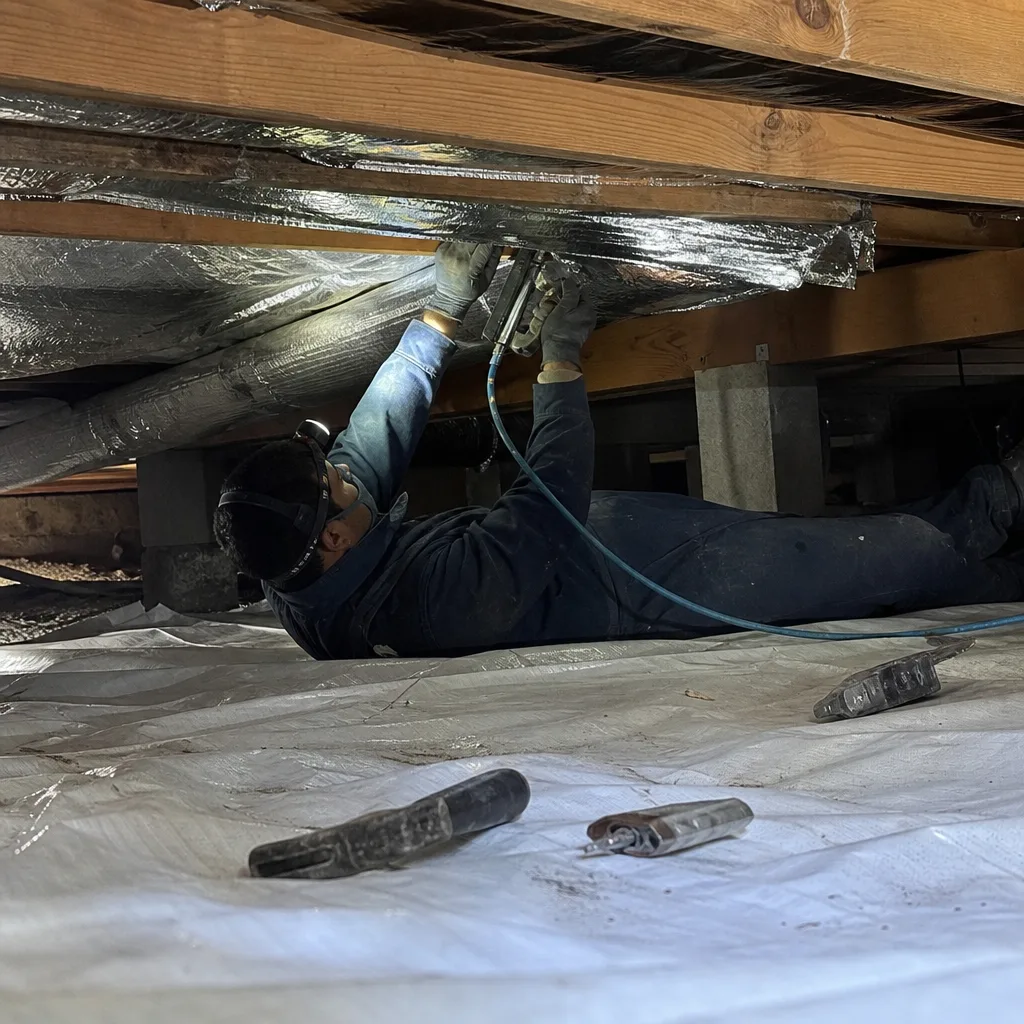
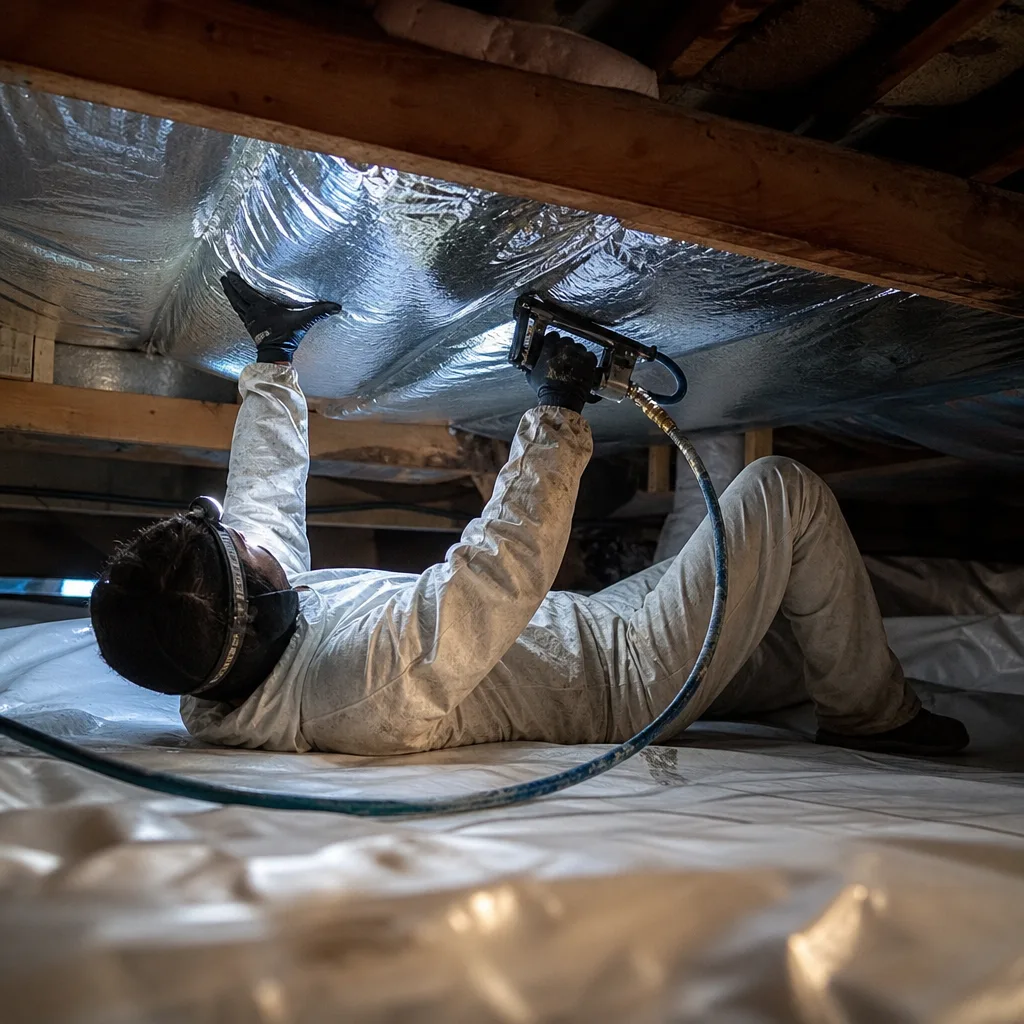
- Installation method chosen. The staple-up method – where foil is stapled directly to the underside of the roof decking or draped across the rafters – gives the best performance because it creates an air gap between the barrier and the decking, which is where the heat-reflection actually happens. The blown-in overlay method, where foil is simply laid over the top of existing attic insulation, costs slightly less in labor but performs differently. We explain the tradeoff clearly during the estimate because the right answer depends on what is already in your attic.
- Air sealing scope. Envelope Insulation Co. treats air sealing as a prerequisite, not an add-on. Before any radiant barrier material goes in, we seal the top plates, penetrations from plumbing and electrical, and any can lights – the recessed lights that punch through the ceiling drywall and are some of the worst air leak points in a Pasadena home. That sealing work costs between $450 and $950 depending on the number of penetrations, and it is listed as a separate line item in your written price so you can see exactly what you are paying for.
- Attic temperature and seasonality. This one is specific to Southern California: installations scheduled during Pasadena’s hottest weeks – typically late July through mid-September – take longer because crew time in a 150°F+ attic is limited for safety reasons. Scheduling in spring (March through May) or fall (October through November) usually results in faster installs and, in some cases, slightly tighter scheduling windows with the crew. We do not manufacture seasonal urgency, but the physics of attic work in Pasadena’s summers are real.
How to Save on Radiant Barrier Installation
The most direct way to pay less is to schedule an estimate before summer heat sets in. By late May in Pasadena, every insulation contractor in the San Gabriel Valley is running a full schedule. Jobs booked in February or March tend to get more installation flexibility, and the attic is not yet at peak temperature, which means the crew can move faster. A faster install costs less in labor.
Second: ask for the full written scope upfront and read every line. We have seen homeowners in Pasadena accept bids that looked low but excluded attic air sealing entirely – meaning the radiant barrier went in over an attic full of air leaks, and the cooling savings never materialized the way they should have. A radiant barrier slows radiant heat gain. It does not fix the fact that your conditioned air is escaping through 40 unsealed can lights. If a quote does not include air sealing, ask the contractor to explain what they intend to do about your penetrations. Under Haven Standard Clause 1, our written price lists air sealing as a separate, explicit line – you will always know what is and is not included.
Third: if you are already planning to address attic insulation – adding blown-in, or replacing old insulation that has become contaminated or settled – bundling that work with the radiant barrier installation saves mobilization cost. Separate trips mean separate setup time; the same crew doing both in one visit is more efficient and that shows up in the price.
Fourth: take advantage of utility rebates. Southern California Edison and the City of Pasadena’s energy programs have, in recent years, offered rebates on radiant barrier installations when paired with other qualifying insulation upgrades. Rebate programs change frequently, and we do not quote specific rebate amounts on a static page because the numbers shift – but we can tell you during your estimate what programs are currently active and whether your planned work qualifies. That conversation costs nothing.
Fifth: use the Free Second Opinion. If you have a written estimate from another contractor, bring it to us. Under our standard process, we will read it with you line by line and explain what each item means in terms of what the crew will actually do in your attic. There is no charge for that, and no obligation. Call (213) 816-5351 to set it up, or request it through the estimate process.
One thing that does not save money: skipping air sealing to reduce the upfront cost. In Pasadena’s climate, a radiant barrier installed over an unsealed attic underperforms relative to its rated potential. You pay for the full barrier and see a fraction of the energy benefit. The payback period stretches out, and the only fix is to come back later and do the air sealing anyway. We will not recommend skipping it, and we explain why in the written scope.
Is a Radiant Barrier Worth the Cost in Pasadena?
Pasadena sits in the San Gabriel Valley, inland from the coast, which means it does not get the marine-layer cooling that communities like Santa Monica or Culver City see on summer nights. Temperatures in Pasadena regularly hit the upper 90s and occasionally break 100°F during heat events – and in an attic without a radiant barrier, that translates to 140°F to 160°F on the underside of the roof decking. That heat load radiates down into your living space regardless of how much fiberglass or cellulose insulation you have on the attic floor, because traditional insulation slows conductive heat transfer, not radiant heat.
A foil radiant barrier reflects 95 to 97 percent of that radiant energy back out before it reaches your insulation layer. The Department of Energy’s own data suggests that in hot climates like Pasadena’s, a properly installed radiant barrier can reduce attic heat gain by 25 to 40 percent – and cooling cost reductions of 5 to 15 percent on the AC portion of the utility bill are consistently documented in California studies on homes that matched our typical Pasadena job profile.
On a $1,800 to $2,400 installation, a 10 percent reduction in a $250/month summer cooling bill represents roughly $25 per month in savings during the peak four-to-five-month cooling season. That math produces a payback period of roughly six to ten years on the radiant barrier alone – before accounting for the air sealing work done at the same time, which typically shows a faster payback. Homes in Pasadena’s hotter inland pockets, like the areas east of Sierra Madre Villa, tend to see returns on the shorter end of that range.
We do not guarantee specific savings percentages – the actual result depends on your home’s existing insulation level, your AC equipment efficiency, and how you use the house. What we can document is the before-and-after blower-door test reading on applicable combined jobs, which shows in a single measured figure how much conditioned air your building envelope was losing before sealing and after. That number is yours, in writing, when we leave.
Radiant Barrier vs. Adding More Attic Insulation: Which One First?
This question comes up on nearly every Pasadena estimate because most homes in the area are underinsulated by current California standards, and homeowners are trying to decide where to spend first. The short answer: it depends on what you currently have, and the answer changes at roughly R-30.
If your attic insulation is below R-19 – which applies to a significant number of Pasadena bungalows built before 1980 that have never been updated – bringing the insulation up to code-minimum levels (R-38 for new construction in Climate Zone 9, which covers most of Pasadena) will almost always deliver a bigger return than installing a radiant barrier over thin insulation. Insulation deals with conductive heat transfer; a radiant barrier deals with radiant heat. You need a base level of insulation for the home to perform well before the radiant barrier adds meaningful marginal value.
If your attic floor already has R-30 or more, a radiant barrier becomes the higher-leverage next investment in Pasadena’s climate – because at that insulation depth, conductive heat transfer is already reasonably managed, and the dominant remaining pathway for heat is radiant gain from the roof decking above. That is exactly what the foil addresses.
We sequence this in writing during every estimate. The scope tells you what we recommend, in what order, and why – not as a sales exercise, but because the documentation is part of the job. You can read our full Radiant Barrier Installation in Pasadena service page for more on how we approach sequencing and what an installation actually involves step by step.
What the Installation Process Looks Like
Understanding the process helps you evaluate any quote more accurately – because the steps a contractor skips are usually where the savings come from on a low bid.
On a standard Pasadena job, the process runs as follows. First, a technician does a walk-through of the attic and produces a written scope with a flat price. That scope lists attic square footage, installation method, air sealing scope, materials to be used, and the warranty terms. No work starts without your signature on that document – that is Haven Standard Clause 1, and it is not optional on our end.
Before any foil goes up, the crew seals every penetration on the attic floor: top plates where interior walls meet the attic, electrical and plumbing penetrations, and any recessed can lights. In a typical 1970s Pasadena ranch or post-war tract home, this can mean 20 to 60 individual penetration points. Each one is sealed with the appropriate material – fire-rated caulk, foam, or sheet metal, depending on the location and clearance requirements. This is the air sealing work that the radiant barrier depends on to perform correctly.
After sealing is complete, the foil is installed. On a staple-up job, it is run across the rafters with staples every 12 to 16 inches and seams lapped and taped. The crew leaves a small gap at the ridge and the soffits to allow the barrier to breathe – an important detail that prevents moisture buildup in Pasadena’s occasional humid periods during winter and spring. On an overlay job, the foil is laid flat over the existing insulation with the reflective side facing up.
When the crew leaves, you receive a Documented Photo Record – photos of the sealed penetrations, the barrier installation, any conditions noted during the job – and, on applicable combined jobs, a before-and-after blower-door reading. The blower-door test is a pressurization measurement: a calibrated fan mounted in an exterior door depressurizes the house to a standard pressure difference, and the machine measures in CFM50 (cubic feet per minute at 50 Pascals of pressure) how much air is moving through the building envelope. A house that read 3,800 CFM50 before sealing and 2,200 after is a house where you can see, in those two numbers, what the sealing work accomplished. That documentation is part of what you paid for.
What Pasadena Homeowners Often Ask Before Getting a Quote
Most of the questions we hear before an estimate fall into three categories: whether the house is a good candidate, what the job will disrupt, and whether the permit situation is something to worry about.
On permit requirements: in most cases, radiant barrier installation in Pasadena does not require a permit under the current City of Pasadena building code when the work is limited to the attic and does not involve structural changes. However, if the project is being paired with electrical work – rerouting attic wiring to improve accessibility, for example, or replacing knob-and-tube wiring that is buried under old insulation – a permit is required for the electrical portion. We will tell you during the estimate what triggers a permit requirement based on the specific scope of your job. We do not quote work that requires a permit without acknowledging it in the written scope.
On disruption: a standard Pasadena radiant barrier installation takes four to eight hours for a single crew, depending on attic size and complexity. You do not need to leave the house. The crew works through the attic access and is not in your living space. Dust control matters at the hatch opening, and we protect the area below it. The home is fully usable during and after installation.
On candidacy: attic radiant barriers perform best in homes with air conditioning and in climates where cooling is the dominant load – which describes most of Pasadena most of the year. Homes that rely primarily on evaporative cooling benefit differently, because the economics of the heat reduction change when the mechanical cooling system is less expensive to run. We cover this during the estimate and explain how it affects the payback calculation for your specific home.
FAQs – Radiant Barrier Installation Cost in Pasadena
How much does radiant barrier installation cost in Pasadena, CA?
Most radiant barrier installations in Pasadena run between $1,400 and $3,200, with the majority of single-story homes landing between $1,800 and $2,600 depending on attic size, access, and whether air sealing is included. Homes with complex rooflines – hip roofs, multiple gable intersections, or low ridge heights – typically fall in the upper third of that range. Call (213) 816-5351 for a written estimate specific to your home’s square footage and condition; the estimate is free and includes a flat price before any work is scheduled.
Is a radiant barrier worth it in Pasadena’s climate?
Yes, for most Pasadena homes with air conditioning and attic insulation at or above R-25, a radiant barrier is a high-value next step. Pasadena’s inland location means summer attic temperatures routinely reach 150°F or higher – conditions where radiant heat gain is the dominant thermal load and foil barriers perform best. Studies on California homes in similar climate zones document cooling cost reductions of 5 to 15 percent from radiant barrier installation alone. The payback period on a $1,800 to $2,400 installation at that savings rate is typically six to ten years, shorter in homes with higher baseline cooling costs.
Does radiant barrier installation require a permit in Pasadena?
Radiant barrier installation on its own – foil stapled or laid in the attic without structural changes – generally does not require a permit under current City of Pasadena building codes. If the scope of work includes electrical modifications, attic ventilation changes requiring framing work, or insulation removal that involves working around knob-and-tube wiring, permit requirements may apply to those components. We identify permit triggers during the estimate and document them in the written scope before work begins.
How long does radiant barrier installation take in a typical Pasadena home?
Most Pasadena installations are completed in four to eight hours for a standard single-story home. A 1,500 sq ft attic with good access and straightforward framing typically takes four to five hours including air sealing. A 2,200 sq ft attic with a hip roof, multiple valleys, and limited headroom – common in older Pasadena estates and some of the larger post-war homes along Oak Knoll – can take a full day. The written scope we provide before work starts includes an estimated crew time so you can plan around the appointment.
What is the difference between single-sided and double-sided radiant barrier foil, and which costs more?
Single-sided radiant barrier foil has one reflective face and runs $0.10 to $0.20 per square foot in material cost. Double-sided foil reflects from both surfaces and costs $0.18 to $0.35 per square foot – useful when the barrier might face heat sources from below as well as above, or in certain overlay configurations. Perforated foil (which has small holes to allow moisture vapor to pass through) adds a few cents per square foot but is often the better choice for Pasadena’s winter and spring periods when marine-layer humidity moves into the valley. We specify the correct product for your attic configuration in the written scope, with the material listed by type so you know exactly what is going in.
Can a radiant barrier be installed over existing attic insulation in Pasadena?
Yes, in many cases. When existing attic insulation is in good condition and at adequate depth (roughly R-19 or more), a perforated foil radiant barrier can be laid over it with the reflective side facing up. This overlay method costs slightly less in labor – typically $0.55 to $0.90 per sq ft versus $0.65 to $1.10 for the staple-up rafter method – and is practical in attics where the insulation does not need to be disturbed. If the existing insulation is compressed, contaminated, or below code minimums, we will say so in the written scope and give you a separate line item for remediation so you can make an informed decision before any work starts.
Get a Written Price Before Any Work Starts
If you are trying to decide whether a radiant barrier is the right next step for your Pasadena home – or comparing it against adding insulation or addressing a known air leakage problem – the most useful thing you can do is get a written estimate that spells out the scope, the materials, and the flat price before any work is scheduled. That is the only way quotes from different contractors become comparable on the same terms.
At Envelope Insulation Co., every estimate starts with a technician in your attic, not a number generated off square footage alone. We look at your existing insulation depth and condition, count the penetrations that need sealing, assess attic access, and measure the framing geometry before we quote anything. The written scope you receive names the installation method, the foil type, the air sealing locations, the timeline, and the warranty – all at a flat price that does not change when the crew shows up.
The 365-Day Done Right Promise applies to every completed job. If something was not done to the written scope, we make it right – and that promise is in writing before anyone lifts a tool.
To schedule a free estimate for Radiant Barrier Installation in Pasadena, or to bring in a competing quote for a free second opinion, call (213) 816-5351. A live person answers – no voicemail, no callback window measured in days. If you found this guide through the home page or are comparing options across our full service line, the same number reaches the same crew.
We have completed over 9,000 homes sealed and insulated since 2016 – every one with a written price before work started and a documented photo record when the crew left. Pasadena is a significant part of that work, and the pricing ranges on this page reflect what we actually charge in this market, not a national estimate adjusted by zip code.
Written by Wes Okafor, Owner at Envelope Insulation Co. (operating as Topside Attic Insulation Pasadena), serving Pasadena since 2016. Pricing reflects the Pasadena, CA market as of 2026. Topside Attic Insulation Pasadena offers free written estimates – call (213) 816-5351.
What Our Customers Say
"The winter gas bill dropped by about a third. They had estimated a quarter, so they under-promised."
- Genevieve R."Crawl space encapsulation done properly. Photographs of the vapour barrier at every seam, and the damp smell in the hallway is gone."
- Ainsley P."Turned up on time, protected the hallway, and the written scope matched what was actually done."
- Bruno S.